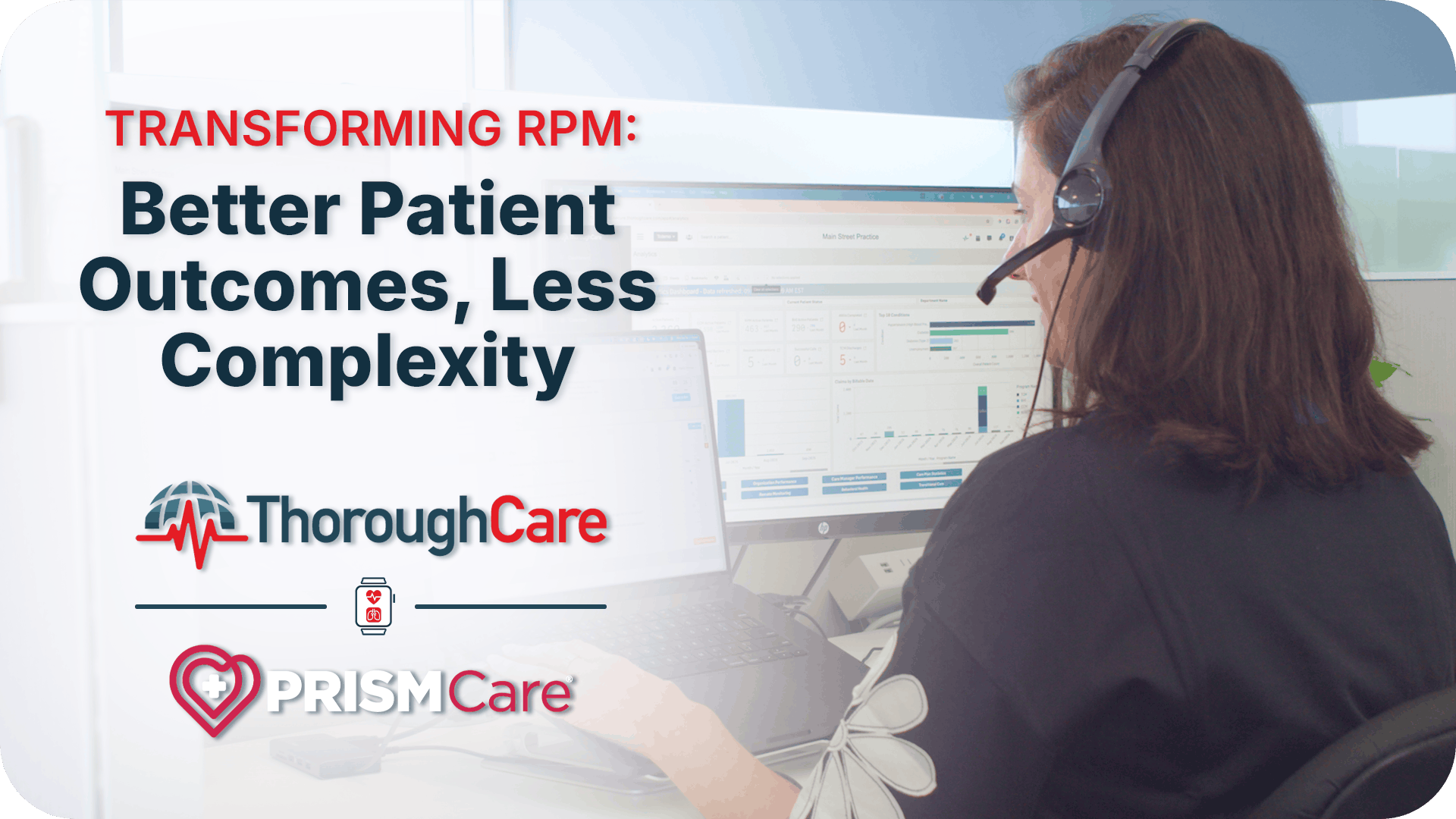

Remote Patient Monitoring (RPM) gives healthcare providers an opportunity to stay connected with patients between office visits, identify potential health concerns earlier, and support better management of chronic conditions. However, implementing and managing an effective RPM program can be challenging for physician practices. Device management, monthly data collection requirements, staffing limitations, and ongoing patient engagement can create significant operational and financial hurdles.
Prism Care, led by CEO Kerry Brooks, helps physician practices overcome these challenges through a combination of dedicated care management services and ThoroughCare's care coordination technology.
By using ThoroughCare to capture real-time patient data, monitor important health metrics, and coordinate interventions with physician practices, Prism Care helps extend care beyond the traditional office visit while reducing the administrative burden on providers.
Overcoming the Challenges of Implementing Remote Patient Monitoring
Although RPM can improve chronic disease management, many physician practices struggle to implement and maintain these programs independently.
According to Kerry Brooks, one of the biggest challenges is the operational complexity involved in running an RPM program. Practices must manage monitoring devices, collect patient readings consistently, meet program requirements for data transmission, and maintain regular communication with patients.
Staffing can make these responsibilities even more difficult. Many practices lack the additional personnel needed to manage ongoing patient monitoring while maintaining their existing clinical workflows.
Prism Care addresses these challenges by providing the operational support needed to manage RPM programs. Through its partnership with ThoroughCare, Prism Care helps practices offer remote monitoring without requiring them to hire additional staff or take on the financial and device-related risks associated with implementing an RPM program themselves.
As Brooks explains, the goal is to make RPM accessible to practices without introducing unnecessary stress or operational complexity.
Making Remote Patient Monitoring Financially Accessible for Physician Practices
One of the most significant barriers to RPM adoption is the potential financial investment required to launch and maintain a program.
Practices may be hesitant to invest in monitoring equipment, dedicate staff resources, and establish new workflows without knowing whether the program will generate a positive return.
Prism Care's approach helps reduce these barriers.
By managing the RPM process in partnership with physician practices, Prism Care eliminates the need for practices to hire additional personnel or assume device-related financial risks. Brooks notes that even one patient enrolled through Prism Care and supported by ThoroughCare can make a practice profitable.
This model allows providers to participate in RPM and expand their patient care capabilities without taking on the same operational responsibilities they would face managing the program independently.
Extending Patient Care Beyond the Physician's Office
For patients living with multiple chronic conditions, managing their health requires more than occasional appointments.
Many patients may only see their physician three or four times per year. Between those visits, changes in their health can go unnoticed without consistent monitoring and support.
Prism Care helps bridge this gap by maintaining regular contact with patients and monitoring their health between office visits.
Through RPM, the Prism Care team can track important health metrics, identify concerning changes, and provide patients with coaching and encouragement to help them follow healthier routines.
Brooks emphasizes the importance of working with patients who may have multiple comorbidities and have never had consistent support or guidance in managing their conditions.
With ongoing engagement, education, and accountability, Prism Care helps patients better understand their health and make progress toward healthier outcomes.
Using Real-Time RPM Data to Identify Potential Health Concerns
Timely access to patient health information is one of the most important benefits of Remote Patient Monitoring.
Through ThoroughCare, Prism Care can capture patient readings and monitor key health indicators in real time. This visibility allows the care team to identify potentially concerning changes and respond when patients need additional attention.
If a patient submits a critical RPM reading, the information triggers an alert. The Prism Care team can immediately contact the patient to assess the situation and determine the appropriate next steps.
When necessary, the team escalates the concern to the physician and other members of the practice's care team. If a situation is particularly serious, the patient may be directed to seek emergency care.
This coordinated approach helps ensure that important changes in a patient's health do not go unnoticed between scheduled appointments.
Rather than relying solely on information collected during office visits, physicians have access to additional data that can help them better understand how their patients are doing over time.
Tracking Blood Pressure and Pulse Oximetry to Measure Patient Progress
ThoroughCare gives Prism Care access to extensive patient data that can be used to evaluate health trends and measure progress.
Two particularly important metrics for Prism Care are:
Blood Pressure: Monitoring blood pressure over time helps the care team understand how patients with hypertension and other chronic conditions are progressing. Prism Care pays particular attention to changes during the first 90 days of monitoring to establish a baseline and identify improvements or concerning trends.
Pulse Oximetry: Pulse oximetry readings provide insight into a patient's blood oxygen saturation. By tracking these measurements through RPM, the care team can monitor changes and identify readings that may require additional attention.
Access to real-time data makes it easier for Prism Care to evaluate these metrics, recognize patterns, and respond when intervention is needed.
More importantly, this information helps establish a measurable starting point for each patient.
Turning Patient Data Into Meaningful Health Improvements
Collecting patient health data is only part of an effective RPM program. The real value comes from using that information to guide care and help patients understand their progress.
Brooks explains that ThoroughCare gives Prism Care the ability to establish a clear picture of where a patient is today and where they need to be.
For example, when a patient's blood pressure decreases by 10%, the care team can recognize that improvement and share the progress with the patient.
These measurable milestones give patients tangible evidence that their efforts are making a difference. Celebrating improvements can reinforce positive behaviors, encourage continued engagement, and help patients stay motivated throughout their care journey.
Without access to consistent patient data, these improvements may be difficult for care teams and patients to recognize.
With ThoroughCare, Prism Care can use real-time information to turn monitoring data into meaningful conversations about health and progress.
How ThoroughCare Supports Prism Care's Remote Patient Monitoring Program
Prism Care's partnership with ThoroughCare demonstrates how care management organizations can use technology to deliver more consistent, data-driven patient support while helping physician practices overcome the challenges of implementing RPM.
ThoroughCare provides the technology Prism Care needs to:
- Capture real-time patient data: Monitor important health indicators and maintain visibility into patient health between appointments.
- Identify critical readings: Flag concerning measurements so the care team can quickly assess and respond.
- Coordinate care with physicians: Share relevant patient information and involve the appropriate members of the practice's care team when intervention is needed.
- Track patient progress: Evaluate changes in blood pressure, pulse oximetry, and other important health metrics over time.
- Support patient engagement: Give care teams measurable information they can use to encourage patients and reinforce healthier behaviors.
Together, Prism Care's care management services and ThoroughCare's technology help create a more connected approach to chronic disease management.
Improving Chronic Care Management Through Consistent Monitoring and Engagement
For Prism Care, successful Remote Patient Monitoring is about more than collecting readings or meeting program requirements. It is about building relationships with patients, identifying opportunities for intervention, and helping people take meaningful steps toward better health.
By combining consistent patient engagement with real-time health data, Prism Care can support patients between physician visits while giving providers a more complete understanding of their patients' health.
As Brooks describes it, the ability to recognize improvements, celebrate progress, and help patients change their health trajectories is one of the most rewarding aspects of the work.
With ThoroughCare, Prism Care is helping physician practices simplify RPM implementation, improve care coordination, and deliver more proactive support to patients living with chronic conditions.
Frequently Asked Questions About Prism Care and Remote Patient Monitoring
How does Prism Care use ThoroughCare for Remote Patient Monitoring?
Prism Care uses ThoroughCare to capture and monitor real-time patient health data, track important metrics such as blood pressure and pulse oximetry, identify critical readings, and coordinate interventions with physician practices.
How does ThoroughCare help physician practices implement RPM?
ThoroughCare supports Prism Care's RPM operations by providing technology for patient monitoring, data collection, alerts, and care coordination. Combined with Prism Care's services, this approach helps practices participate in RPM without hiring additional staff or taking on device-related financial risks.
What health metrics does Prism Care monitor through RPM?
Prism Care places particular emphasis on blood pressure and pulse oximetry. Monitoring these metrics over time helps the care team identify health trends, recognize potential concerns, and measure patient progress.
How does Remote Patient Monitoring improve care between office visits?
RPM allows care teams to monitor patients and review health information outside of scheduled appointments. This creates opportunities to identify concerning changes, communicate with patients, and coordinate timely interventions.
How does RPM help patients with chronic conditions?
RPM supports patients with chronic conditions through consistent monitoring, ongoing engagement, and coaching. It helps care teams identify changes in health status and gives patients measurable feedback about their progress.
About Prism Care
Prism Care is a healthcare organization that partners with physician practices to deliver care management services, including Remote Patient Monitoring. Under the leadership of CEO Kerry Brooks, Prism Care uses ThoroughCare to streamline RPM operations, monitor patient health data, and coordinate care with physician practices.
About ThoroughCare
ThoroughCare provides leading care coordination software that helps healthcare organizations manage and scale value-based care programs. Its platform supports care management workflows, patient engagement, clinical documentation, data collection, and analytics to help providers improve care coordination, monitor patient outcomes, and manage chronic conditions.