
Long-term care facilities face a growing challenge with coordinating care across large clinical teams while managing residents with multiple chronic conditions, behavioral health needs, and complex care goals.
For Lumina Care, solving that challenge meant building a scalable, collaborative care management model with ThoroughCare as a partner.
Today, Lumina Care manages approximately 27,000 residents through ThoroughCare’s platform across Chronic Care Management (CCM), Behavioral Health Integration (BHI), and the Collaborative Care Model programs. By combining shared care plans, analytics, and multidisciplinary collaboration, the organization has significantly improved care coordination and achieved an average hospitalization rate of 2% among providers implementing Lumina Care's After-Hours Telehealth program.
Why Care Coordination Is One of the Biggest Challenges in Long-Term Care
Long-term care residents often receive services from multiple providers, clinicians, care managers, specialists, and facility staff. Without a centralized system, communication gaps can quickly impact patient outcomes.
According to Laura Geiger, Chief Clinical Officer at Lumina Care, one of the largest operational challenges in long-term care is ensuring every member of the care team is aligned around the same goals, interventions, and patient progress.
That’s where structured, collaborative care planning becomes essential.
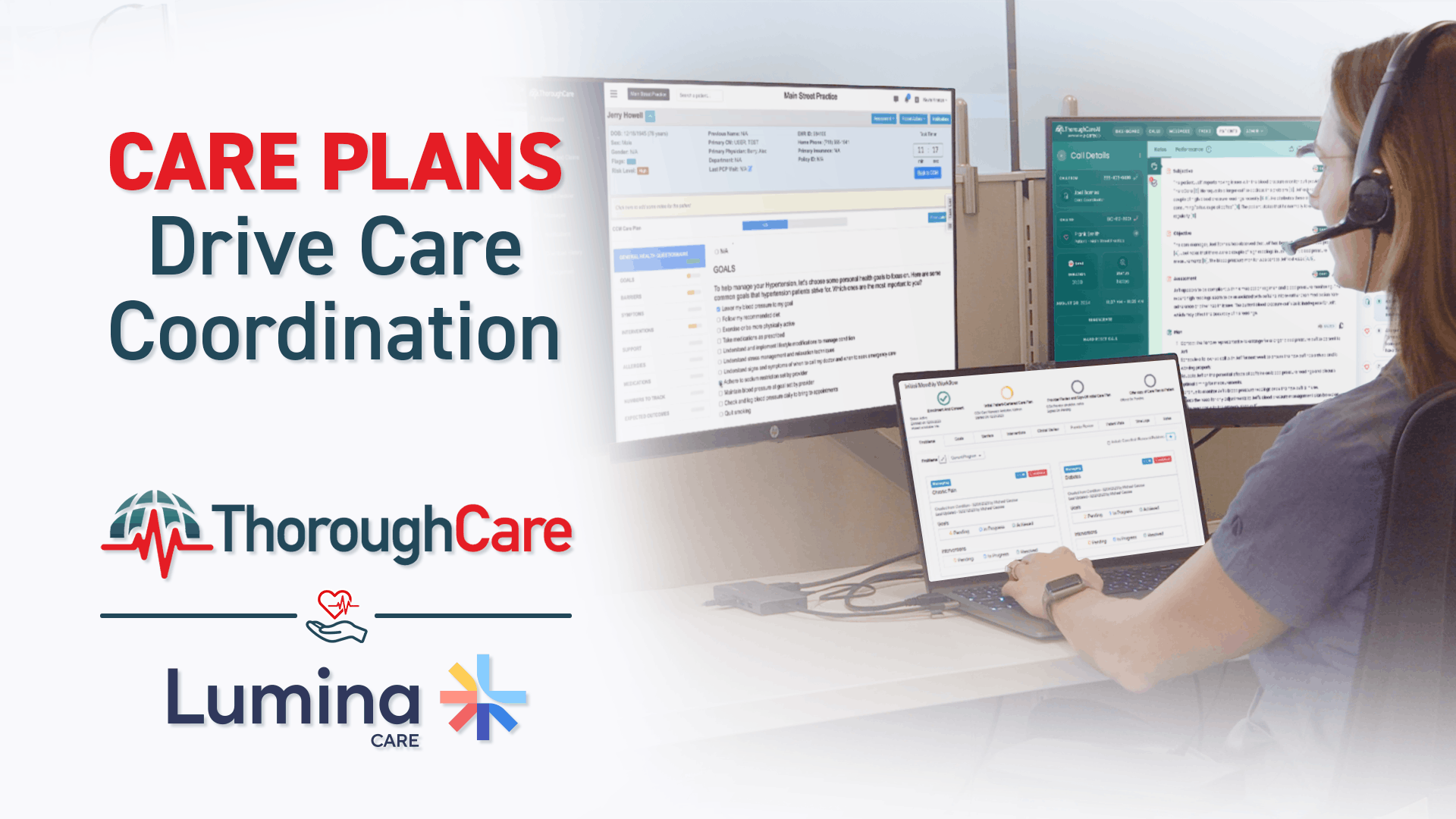
Using ThoroughCare, Lumina Care developed a workflow where clinicians and care managers can coordinate directly within a single platform, ensuring every resident’s care plan is visible, actionable, and continuously updated.
How ThoroughCare Supports Collaborative Care Planning
Lumina Care uses ThoroughCare as the foundation for its care coordination efforts. The platform allows care teams to create individualized care plans that evolve month over month as residents progress toward their goals.
Key elements of the care plans include:
- Chronic condition tracking
- SMART goals for measurable progress
- Interventions and follow-up actions
- Medication management
- Immunizations and allergy documentation
- Diagnostic monitoring and reporting
- Barrier identification and resolution tracking
This structure gives clinicians and care managers a shared view of each resident’s health journey.
For example, a clinician managing diabetes complications can collaborate directly with a care manager supporting dementia-related care needs for the same resident. Both teams can contribute to the care plan, monitor outcomes, and adjust interventions together.
Scaling Care Coordination Across Hundreds of Providers
One of the most impressive aspects of Lumina Care’s model is its scale.
The organization currently supports:
- More than 250 care managers
- More than 150 clinicians
- Approximately 27,000 managed residents
Coordinating care across teams of that size requires standardized workflows and centralized visibility into patient progress.
ThoroughCare’s platform helps Lumina Care streamline communication and maintain continuity of care across all participating programs.
By giving every stakeholder access to the same care plan and resident data, the platform reduces fragmentation and improves clinical alignment.
Using Analytics to Improve Resident Outcomes
Beyond care planning, Lumina Care also leverages ThoroughCare’s Analytics capabilities to evaluate whether interventions and goals are driving meaningful clinical improvements.
This data-driven approach allows the organization to:
- Measure program effectiveness
- Identify trends in resident outcomes
- Optimize interventions over time
- Demonstrate value to facility partners
- Support expansion into additional care delivery programs
Analytics also help validate clinical performance with measurable outcomes that long-term care facilities can clearly understand.
Achieving a 2% Hospitalization Rate
One of the most significant outcomes Lumina Care reports is a hospitalization rate of 2% among providers implementing Lumina Care's After-Hours Telehealth program.
Reducing avoidable hospitalizations is a major priority in long-term care because hospital transfers can increase costs, disrupt continuity of care, and negatively impact resident health outcomes.
By improving care coordination, proactively managing chronic conditions, and aligning interdisciplinary teams around shared goals, Lumina Care has created a more preventative and resident-focused model of care.
The organization attributes much of this success to the visibility and collaboration enabled through ThoroughCare’s care planning platform.
The Future of Long-Term Care Management
As long-term care organizations continue to manage increasingly complex resident populations, scalable care coordination technology is becoming essential.
Platforms like ThoroughCare help organizations move beyond fragmented communication and toward integrated, outcomes-driven care management.
For Lumina Care, the combination of collaborative care plans, analytics, and interdisciplinary teamwork has enabled measurable improvements in resident care while supporting rapid organizational growth.
The result is a more connected care experience for residents, clinicians, care managers, and facility partners alike.
FAQ
What is care coordination in long-term care?
Care coordination in long-term care involves aligning clinicians, care managers, specialists, and facility staff around a shared care plan to improve resident outcomes and reduce gaps in care.
How does ThoroughCare help long-term care organizations?
ThoroughCare provides collaborative care planning, chronic condition management, analytics, and workflow tools that help organizations coordinate care across multidisciplinary teams.
What programs does Lumina Care manage through ThoroughCare?
Lumina Care uses ThoroughCare for Chronic Care Management (CCM), Behavioral Health Integration (BHI), and Collaborative Care Model programs.
How many residents does Lumina Care manage?
Lumina Care manages approximately 27,000 residents through ThoroughCare’s platform.
What outcomes has Lumina Care achieved?
Lumina Care reports a 2% hospitalization rate among providers implementing Lumina Care's After-Hours Telehealth program. and improved care coordination through collaborative care planning and analytics-driven interventions.